


SF-HP Heat-Pulse Sap Flow Sensors
Like TDP sap flow sensors, Heat-Pulse sap flow sensors (HP) are also based on a temperature-based measurement principle. Instead of continuous heating, however, only a short heat pulse is applied. The temporal and directional propagation of this heat pulse is used to determine the sap flow velocity and flow direction of the xylem sap.
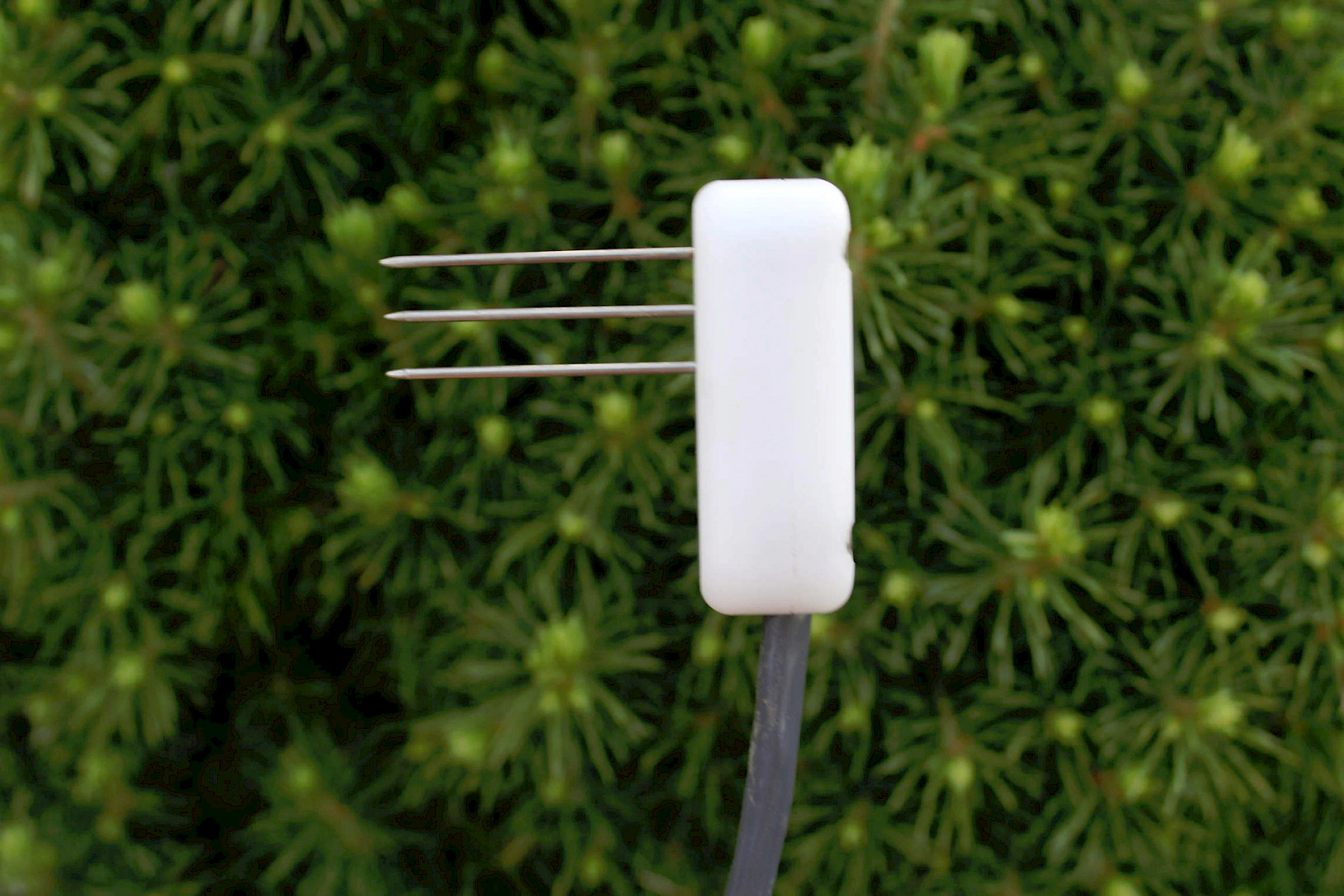
HP sap flow sensors consist of three parallel-arranged sensor probes (N3): a centrally positioned heater needle and two measurement needles located at a distance of 6 mm from the heater on either side. Depending on the sensor configuration, the measurement probes contain one or multiple sensing points/measurement depths (D1, D2, or D3), allowing the radial profile of sap flow within the xylem to be captured across different xylem depths.
The low energy demand enables the use of HP sap flow sensors in battery-powered low-power applications, for example in the IoT field (see IoP).
We currently offer the following configurations:
- SF-HP-N3D1 (10 mm): Needle length 10 mm, one measurement depth at 5 mm distance from the sensor head.
- SF-HP-N3D1 (15 mm): Needle length 15 mm, one measurement depth at 10 mm distance from the sensor head.
- SF-HP-N3D2: Needle length 30 mm, two measurement depths at 10 mm and 20 mm distance from the sensor head.
- SF-HP-N3D3: Needle length 35 mm, three measurement depths at 5 mm, 17.5 mm, and 30 mm distance from the sensor head.
Customized needle lengths and measurement positions, for example for small stem diameters or specific applications, are available on request.
Different Heat-Pulse Sapflow Sensor Models
| Available models | Sensor needle length | Measurement points / measurement depths |
| SF-HP-N3D1 (10 mm) | 10 mm | at 5 mm |
| SF-HP-N3D1 (15 mm) | 15 mm | at 10 mm |
| SF-HP-N3D2 | 30 mm | at 10 mm and 20 mm |
| SF-HP-N3D3 | 35 mm | at 5 mm, 17.5 mm and 30 mm |
Advantages of HP-Sap Flow Sensors
- Significantly lower energy consumption compared to juice flow sensors with constant heating (e.g. TDP sensors such as SF-G or SF-L).
- Equipped with several measuring points in each measurement needle, the radial sap flow depth profile can be recorded.
- The three-wire sensor design enables the direction of flow to be determined, i.e. also the detection of reverse flux as well as the use of the "Dual Method Approach" which combines the advantages of HRM and Tmax measuring methods and thus allows precise measurements in the entire range from slow to fast sap flow velocities.
- The underlying measuring principle itself is less susceptible to natural temperature gradients than compared to that of TDP sensors.
- Analogue output signal stronger (in the range of volts) than with TDP sensors (signals in the range of 1 millivolt), i.e. the relevant requirements for the data logger are significantly lower.
- Sensors are very robust.
Limits of HP-Sap Flow Sensors
- Measurements cannot be taken continuously, i.e. the maximum time resolution is in the range of 10 to 15 minutes.
- Depending on the measurement method used (e.g. HRM, Tmax or DMA), the control of the sensor and the data processing of the sensor data generated during the measurement is relatively complex. The requirements on the data logger are therefore high in terms of measuring frequency, flexible programmability and data processing (Campbell Scientific Logger recommended, or our soon available multi-interface for integration via e.g. RS485).
- Especially in the case of the Tmax and DMA methods, the data logger requires a measurement resolution of 0.01°C and a measurement frequency of at least 2 Hz during the measurement.
- Depending on the sensor model, 4 (SF-HP-N3-D2) or 6 (SF-HP-N3-D3) measurement channels are required.
Technical Data
Sensor designation | Sap Flow Sensor SF-HP-N3D1 (10 mm) | Sap Flow Sensor SF-HP-N3D1 (15 mm) | Sap Flow Sensor SF-HP-N3D2 | Sap Flow Sensor SF-HP-N3D3 |
Application range | For measuring sap flow in plants | For measuring sap flow in plants | For measuring sap flow in plants | For measuring sap flow in plants |
Number and arrangement of sensor needles | 3 sensor needles in one line, needle spacing 6 mm. | 3 sensor needles in one line, needle spacing 6 mm. | 3 sensor needles in one line, needle spacing 6 mm. | 3 sensor needles in one line, needle spacing 6 mm. |
| Measurement depths | One measurement depth at 5 mm from the sensor head | one measurement depth at 10 mm from the sensor head | Two measurement depths at 10 mm and 20 mm from the sensor head | Three measurement depths at 5 mm, 17.5 mm and 30 mm distance from the sensor head |
| Sensor dimensions | Sensor head (H×W×D): 35 mm × 15 mm × 15 mm. Needle diameter: 1.27 mm; Needle length: 10 mm | Sensor head (H×W×D): 35 mm × 15 mm × 15 mm. Needle diameter: 1.27 mm; Needle length: 15 mm | Sensor head (H×W×D): 45 mm × 20 mm × 16 mm. Needle diameter: 1.27 mm; Needle length: 30 mm | Sensor head (H×W×D): 45 mm × 20 mm × 16 mm. Needle diameter: 1.27 mm; Needle length: 35 mm |
Output signal | Analog, voltage 0 to supply voltage Vex (recommended: 1 < Vex < 3.3 VDC) | Analog, voltage 0 to supply voltage Vex (recommended: 1 < Vex < 3.3 VDC) | Analog, voltage 0 to supply voltage Vex (recommended: 1 < Vex < 3.3 VDC) | Analog, voltage 0 to supply voltage Vex (recommended: 1 < Vex < 3.3 VDC) |
Technical requirements for the data logger used | 2× single-ended channels, ≥13 bit resolution (0.01 °C).
| 2× single-ended channels, ≥13 bit resolution (0.01 °C).
| 4× single-ended channels, ≥13 bit resolution (0.01 °C).
| 6× single-ended channels, ≥13 bit resolution (0.01 °C).
|
| Data logging | Flexible options for data logging and transmission:
| Flexible options for data logging and transmission:
| Flexible options for data logging and transmission:
| Flexible options for data logging and transmission:
|
Power supply | SF-HP sensors require two different power supplies: 1.: Switched excitation voltage (Vex) for temperature measurement, recommended: 1 < Vex < 3.3 VDC. Ideally, ratiometric measurement with Vex = Vref of the logger. 2.: Precisely switched heating current, 2 sec. approx. 750 mA at 11 - 13 VDC. Energy consumption per measurement 0.2 mAh at 12 V (2.5 mWh). The usable capacity of a 10 Ah 12 V battery is sufficient for approximately 20,000 measurements. | SF-HP sensors require two different power supplies: 1.: Switched excitation voltage (Vex) for temperature measurement, recommended: 1 < Vex < 3.3 VDC. Ideally, ratiometric measurement with Vex = Vref of the logger. 2.: Precisely switched heating current, 2 sec. approx. 550 mA at 11 - 13 VDC. Energy consumption per measurement 0.3 mAh at 12 V (3.7 mWh). The usable capacity of a 10 Ah 12 V battery is sufficient for approximately 20,000 measurements. | SF-HP sensors require two different power supplies: 1.: Switched excitation voltage (Vex) for temperature measurement, recommended: 1 < Vex < 3.3 VDC. Ideally, ratiometric measurement with Vex = Vref of the logger. 2.: Precisely switched heating current, 6 sec. approx. 325 mA at 11 - 13 VDC. Energy consumption per measurement 0.55 mAh at 12 V (6.5 mWh). The usable capacity of a 10 Ah 12 V battery is sufficient for approximately 10,000 measurements. | SF-HP sensors require two different power supplies: 1.: Switched excitation voltage (Vex) for temperature measurement, recommended: 1 < Vex < 3.3 VDC. Ideally, ratiometric measurement with Vex = Vref of the logger. 2.: Precisely switched heating current, 8 sec. approx. 280 mA at 11 - 13 VDC. Energy consumption per measurement 0.65 mAh at 12 V (7.5 mWh). The usable capacity of a 10 Ah 12 V battery is sufficient for approximately 10,000 measurements. |
Sensor cable length | 5 m, extendable up to max. 25 m | 5 m, extendable up to max. 25 m | 5 m, extendable up to max. 25 m | 5 m, extendable up to max. 25 m |
| Material | Epoxy and Delrin head, stainless steel needles | Epoxy and Delrin head, stainless steel needles | Epoxy and Delrin head, stainless steel needles | Epoxy and Delrin head, stainless steel needles |
Accessories & Compatible Products
Datenlogger and other accessories:
From small and compact solutions to fully developed measurement networks, Ecomatik offers turnkey system solutions for sensor data acquisition in any required size:
- IoP systems (Internet of Plants) for wireless sensor data acquisition at freely positionable measurement points. Customer-specific preconfigured plug-and-play systems with online data visualization and data transmission via NB-IoT/LTE-M or LoRaWAN.
- Maxi systems for customer-specific system integration and individual measurement installations. From planning to implementation of complex measurement networks including sensors, power supply, and data transmission.
- Operation and installation accessories: heating controller, drilling guide, drill bits, mini hex chuck, and reflective insulation.
Note
Operation of Heat Pulse Sap Flow sensors requires, depending on the applied measurement method (HRM, MHR, Tmax, DMA), highly precise timing and high-frequency acquisition of the sensor output signals (at least every 500 ms), as well as accurate control of the heat pulses. For the analog measurement, a low-noise resolution of at least 0.01 °C is required.
All Campbell Scientific data logger systems (Maxi systems) as well as our IoP-MI8 systems meet these requirements.
If you have any questions regarding the compatibility of an existing data logger, please do not hesitate to contact us.
Contact
You need a quotation, have questions about a product, or need extensive technical advice in the context of your project planning. Starting with an initial determination of your needs, through the detailed planning of the required measurement equipment and data transmission technology, up to professional implementation on site, we are at your disposal at any time with advice and action.
General information on order processing
Thank you for your interest in our products and services! Here you will find important information about the ordering process:
To our international customers: Please note, we ship worldwide! If we do not currently have a listed distributor in your country (a list can be found here) , please feel free to contact us directly.
Assessment of your needs
With your consideration and input, we determine which of our products best meet your needs. We are also happy to design fully-integrated measuring stations (plant, climate, soil sensors), including an independent power supply and mobile data transmission, depending on your requirements.
Do you require our assistance before placing an order?
We are happy to help! So that we can provide you with correct and helpful advice, please fill out the online form below with your contact details and other information about your application and send it our way. We will then immediately review your details and contact you.
Are you already familiar with our products and know exactly what you need?
Perfect, then just write us an email! In your order, please state the diameter of your measuring objects in addition to the required cable lengths.
Your contact details and Assessment of your needs
Like so many things, everything started with an idea ...
In the case of the plant scientist and founder of ECOMATIK, Dr. Liu, it was the idea that modern measurement technology should enable crucial plant physiological parameters to be measured directly, precisely and with high temporal resolution on the plant itself. It was obvious to him that there is an information potential of immense value in the detailed understanding of immediate reactions of plants to their environment...